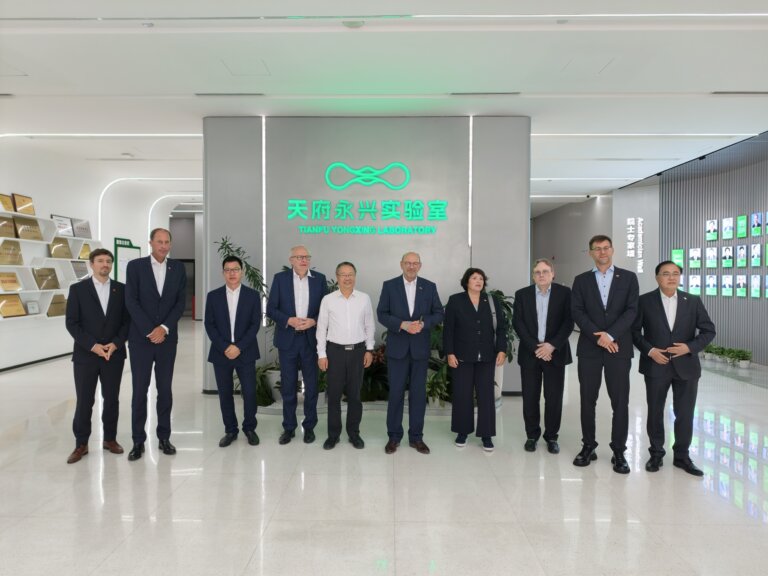
A delegation from the State Parliament of North Rhine-Westphalia (NRW) visited the Tianfu Yongxing Laboratory in Chengdu, Sichuan, to exchange experiences with Sichuan representatives on green and low-carbon energy transition. Building on the Green and Low-Carbon Transition Dialogue held in Düsseldorf in April, the exchange brought together representatives from politics, energy policy, research and industry to discuss how Sichuan and NRW can further cooperate on hydrogen energy, energy storage, smart grids and the integration of energy transition with industrial and regional transformation.
The discussions highlighted that the transition to a low-carbon energy system is closely linked to changes in cities, industrial parks and industrial sectors. Experiences from NRW provided concrete examples of how energy transition can be embedded in broader regional and industrial transformation.
Linking energy transition with regional change
Dr. Ma Shenggui from the Tianfu Yongxing Laboratory presented key observations from his study tour to NRW in June. During the tour, he visited EUREF Campus in Düsseldorf, the Rhenish mining area in Jülich and the Evonik Innovation Factory at Marl Chemical Park. These examples illustrated different approaches to linking changes in energy systems with the transformation of urban areas, former mining regions and industrial sites. For Sichuan, these experiences offer reference points for considering energy not only as an environmental issue, but also as a driver of industrial and regional transformation.
Bringing together infrastructure, industry and energy
The exchange also provided insights into how different sectors can be considered together in regional transformation. Johannes Grünhage, Head of the China Affairs Office of the City of Duisburg, introduced the Port of Duisburg and its experience in coordinating logistics, industry and energy. This perspective complemented the discussion on Sichuan’s energy transition and illustrated the importance of considering infrastructure, industrial activities and energy systems together when developing transformation strategies. Sichuan’s experience and NRW’s regional examples therefore provide different perspectives that can inform continued exchanges between the two regions.
Areas for continued cooperation
The discussions identified several areas for further cooperation, including hydrogen energy, energy storage and smart grids. Sichuan also outlined its efforts to develop a clean, low-carbon, safe and efficient modern energy system. The next phase of cooperation can build on these exchanges by connecting policy communication with technical and industrial cooperation. This includes continued sharing of experiences and exploring practical approaches that reflect the different energy resources, industrial structures and transformation needs of Sichuan and NRW.
The exchange contributes to the wider cooperation under the Sino-German Climate Change and Green Transition Dialogue and Cooperation Mechanism and supports the IKI Energy project “Supporting China’s climate targets through ambitious green and low-carbon energy transition” By linking regional experience with ongoing policy and technical dialogue, the project provides a framework for continued cooperation on China’s green and low-carbon energy transition.