In August 2026, the Sino-German Cooperation on Decarbonising Freight Transport (CDFT) team, together with the German Environment Agency (UBA), conducted a study visit to Shenzhen to gain first-hand insights into Shenzhen’s development of unmanned autonomous delivery, heavy-duty truck electrification, and high-power charging infrastructure. The visit covered their commercial operations, scaling conditions, and zero-emission freight corridor planning.
Unmanned delivery
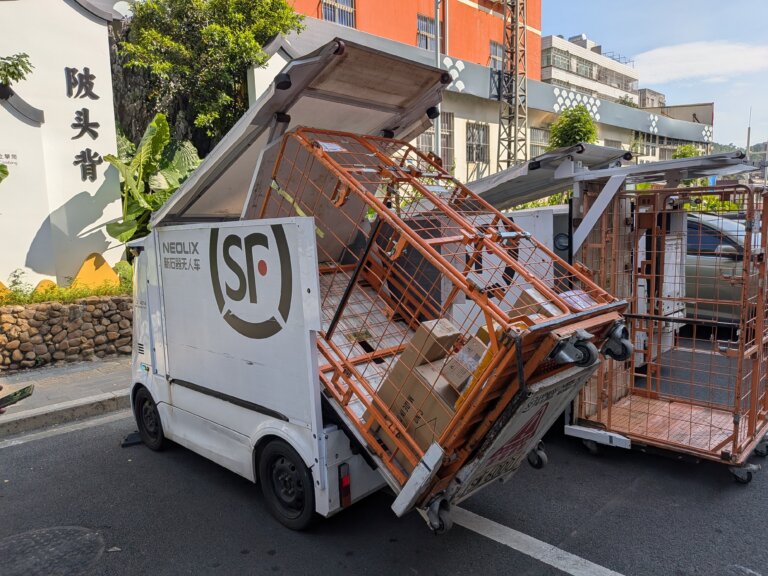
The first focus of the study visit was unmanned delivery. The CDFT team, together with UBA, visited Neolix and observed a Level 4 (L4) autonomous delivery vehicle operating at an SF Express station. The vehicle is currently used primarily for short-distance, high-frequency logistics tasks, including transporting parcels between outlets and collection points, supporting couriers and transferring missorted parcels. The visit offered an example how autonomous vehicles can be integrated into existing logistics operations to automate repetitive and standardised tasks.
Discussions highlighted several factors that can support commercialisation, including high vehicle utilisation, predictable routes, digital fleet management and flexible energy replenishment through charging or battery swapping. At the same time, international deployment faces additional challenges related to vehicle type approval, road access, data protection, data localisation and regulatory requirements. This underlines the importance of early engagement with local authorities and regulatory adaptation when introducing autonomous logistics solutions to international markets.
Zero-emission heavy-duty freight and corridor development
The second focus was Shenzhen’s approach to scaling up the electrification of heavy-duty freight transport. The exchange covered the deployment of new energy heavy-duty trucks, the development of zero-emission freight corridors, high-power charging infrastructure and the integration of freight operations with energy systems.
By the end of 2025, more than 4,300 electric heavy-duty trucks were in operation in Shenzhen, although adoption varied considerably across freight applications. Higher electrification rates were observed in more defined operating environments, such as construction and terminal operations. In contrast, port drayage and other long-distance applications were more limited, as they continue to face greater infrastructure and operational requirements. This underlines the importance of considering vehicle deployment in relation to specific freight demand, route characteristics and operating patterns.
Shenzhen is seeking to scale up these applications through a “Four Vertical and Two Horizontal” zero-emission freight corridor network, covering cross-border fresh-food transport, port collection and distribution, and regional freight transport between Shenzhen, Dongguan and Guangzhou. The experience suggests that the transition from individual vehicle pilots to larger-scale corridor deployment requires coordinated planning of vehicle deployments, routes, charging infrastructure and energy supply. The visit also highlighted the value of selecting high-utilisation freight applications where electrification can achieve both environmental and economic benefits.
High-power charging infrastructure
Shenzhen is expanding high-power and ultra-fast charging facilities at logistics hubs and along major freight corridors. Dedicated charging stations are also increasingly being integrated with logistics parks and fleet operations.
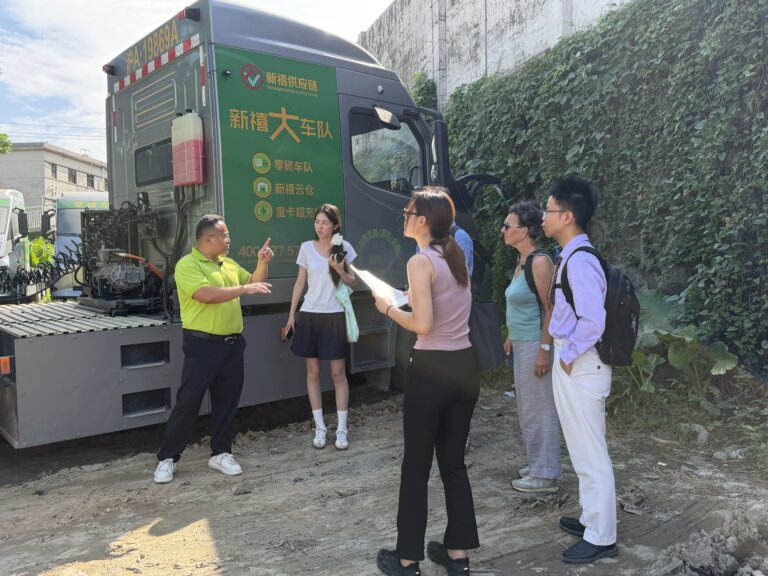
At a charging station serving Yantian Port, the team saw how infrastructure planning can be linked to freight demand and vehicle operations. Discussions with Xinxi Logistics illustrated an integrated model linking freight orders, electric heavy-duty trucks and self-operated charging infrastructure. Predictable freight demand, high vehicle utilisation and coordinated charging can strengthen the business case for electrification.
The discussions also highlighted continuing challenges, including the availability of charging infrastructure, upfront vehicle costs, as well as insurance and freight rates that do not fully reflect the environmental value of low-carbon transport.
Implications
Looking ahead, Shenzhen is expected to further expand zero-emission freight corridors, upgrade high-power charging networks and strengthen digital energy management. Unmanned delivery is also likely to become more integrated with road infrastructure, traffic systems and urban digital platforms.
The Shenzhen experience indicates that scaling up zero-emission heavy-duty freight is increasingly a system-level challenge rather than solely a vehicle technology issue. Successful deployment requires the coordinated development of freight demand, vehicle fleets, charging networks, grid capacity, digital energy management and viable business models, supported by appropriate policy and regulatory frameworks.