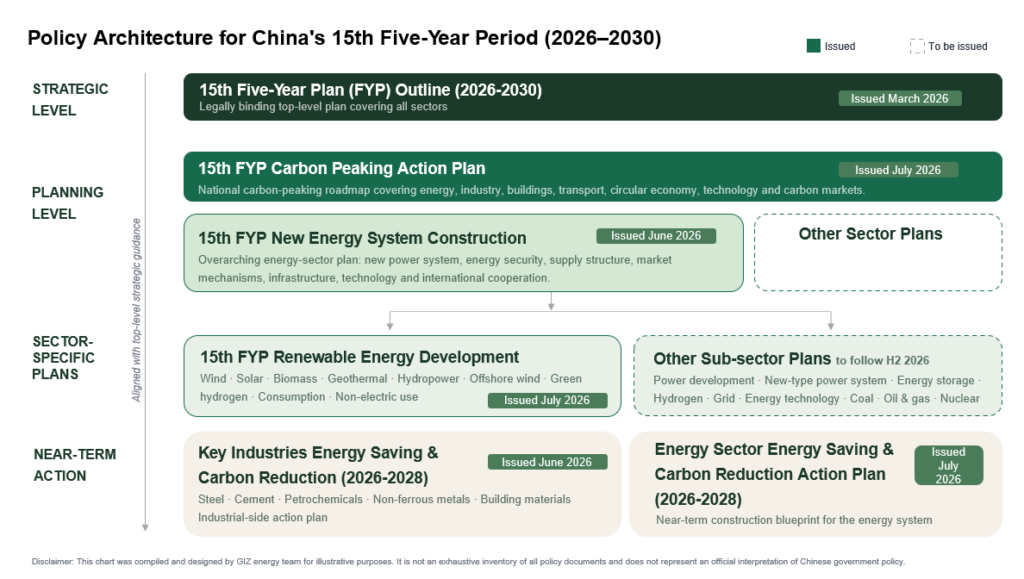
In July 2026, China released a coordinated policy package that defines its energy transition priorities over the next five years. The package consists of the “Carbon Peaking Action Plan during the 15th Five-Year-Plan (FYP) Period” and the “15th FYP for Building a New Energy System”, supported by the first sub-sector renewable energy plan and two near-term action plans for energy conservation and emissions reduction in the power sector and key industries. Together, these documents translate China’s long-term carbon neutrality goal into measurable sectoral targets, infrastructure commitments, and market reforms. The package offers a detailed map of how Beijing intends to move from strategic ambition to project-level implementation during a five-year period that the government describes as critical for peaking carbon emissions.
A system-wide approach to the energy transition
The “15th Five-Year Plan for the New Energy System” provides the overarching framework for the energy sector. Published by the National Development and Reform Commission (NDRC) and National Energy Administration (NEA) on 25 June 2026, it combines renewable deployment with energy security, grid development and changes in energy consumption. By 2030, non-fossil energy is targeted to account for of total energy consumption and 50% of electricity generation. Wind and solar capacity should exceed 2.8 TW, while pumped hydropower and new-type energy storage are planned to reach 160 GW and 300 GW respectively. Distribution grid capacity is also expected to accommodate 900 GW of decentralised renewable generation.
The plan treats the energy transition as an infrastructure and system-management challenge, rather than only a question of generation capacity. Coal is expected to increasingly operate as a flexible balancing resource, while electricity markets, transmission infrastructure, storage and demand-side measures are intended to support higher shares of variable renewable power. At the same time, the plan retains a strong energy-security dimension, including continued domestic oil production, expanded strategic infrastructure and diversified imports.
Renewable energy plan focuses on system reliability
The “Renewable Energy Development Plan”, issued on 23 July 2026 as the first sub-sector plan of the 15th Five-Year Plan period, takes this system approach further. It retains the headline target of more than 2.8 TW of wind and solar capacity by 2030, but adds measures intended to ensure that this capacity can contribute reliably to the power system. Total renewable power capacity is targeted at around 3.5 TW, while renewable energy consumption should reach 1.8 billion tonnes of standard coal equivalent.
A notable change is the introduction of “reliable substitution capacity”. By 2030, wind and solar are expected to provide at least 8% capacity-adjusted guaranteed output, contribute 20% of electricity during summer and winter evening peaks, and add at least 300 GW of renewable-based peak-shaving capacity over the five-year period. These measures suggest that the policy focus is moving beyond installed capacity towards the actual contribution of renewables to system security.
The renewable plan also broadens the transition Non-electric renewable energy use is targeted at 150 million tonnes of standard coal equivalent, renewable hydrogen production at 2 million tonnes annually, and concentrated solar power capacity at 15 GW. It further identifies technologies such as offshore wind, green hydrogen, renewable heating and biomass for development.
Action plans set targets for energy savings and emissions cuts
Two three-year action plans translate the broader energy strategy into near-term implementation between 2026 and 2028. The “Three-Year Action for Energy Saving and Carbon Reduction Upgrades in Key Industries” focuses on energy-intensive industries, covering nine sectors including steel, cement, oil refining and coal-fired power generation. By the end of 2028, it aims to increase the share of production capacity meeting national energy-efficiency benchmark levels by an average of 20% across the targeted industries and by 15% for coal-fired power generation. It also targets more than 100 million tonnes of standard coal equivalent in energy savings and more than 200 million tonnes of carbon dioxide emissions reductions. Investment subsidies, differentiated electricity pricing, carbon-emission substitution mechanisms and carbon-market incentives are intended to support implementation.
The “Energy Sector Energy Saving and Carbon Reduction Action Plan” covers the entire energy value chain, combining supply-side efficiency measures with electrification and low-carbon energy use in industry, transport, buildings, district heating and data centres. By 2028, it targets an annual increase of around 1 percentage point in the share of non-fossil energy in total energy consumption and a 15% increase in the share of coal-fired power capacity meeting national energy-efficiency benchmarks. It also calls for the development of near-zero- and zero-carbon coal mines and oil and gas fields, as well as zero-carbon industrial parks.
On the supply side, measures include retiring coal-fired units of 300 MW or below, upgrading 600 MW units to ultra-supercritical technology, expanding new energy storage and piloting transmission projects supplied entirely by renewable electricity. On the demand side, the plan targets around one million additional new energy heavy-duty trucks by 2028 and seeks to strengthen green electricity and Green Electricity Certificate (GEC) mechanisms.
Coordinating renewables, grid flexibility and energy security through 2030
Taken together, the plans establish a layered policy framework for China’s energy transition through 2030. They connect long-term targets with concrete investments, regulatory reforms and market incentives. For the coming years, the key issue will be how effectively these elements are coordinated to integrate rapidly expanding renewable capacity while maintaining energy security and increasing the role of market-based mechanisms in the energy system.
Original policies:
15th Five-Year Plan for the Construction of a New Energy System
15th Five-Year Plan for Renewable Energy Development
Three-Year Action Plan for Energy Conservation and Carbon Reduction Transformation in Key Industries