To support China’s phaseout of Hydrochlorofluorocarbons (HCFCs) under the Montreal Protocol, a series of activities are being carried out in the commercial refrigeration sector, particularly targeting supermarkets and hypermarkets. As part of the technical support plan, GIZ promotes best practices in refrigerant management, develops technician training programs, and supports the implementation of the industry group standard titled “Specification for Refrigerant Management of Retail Enterprises for Cold Chain Refrigeration Equipment and Systems”.
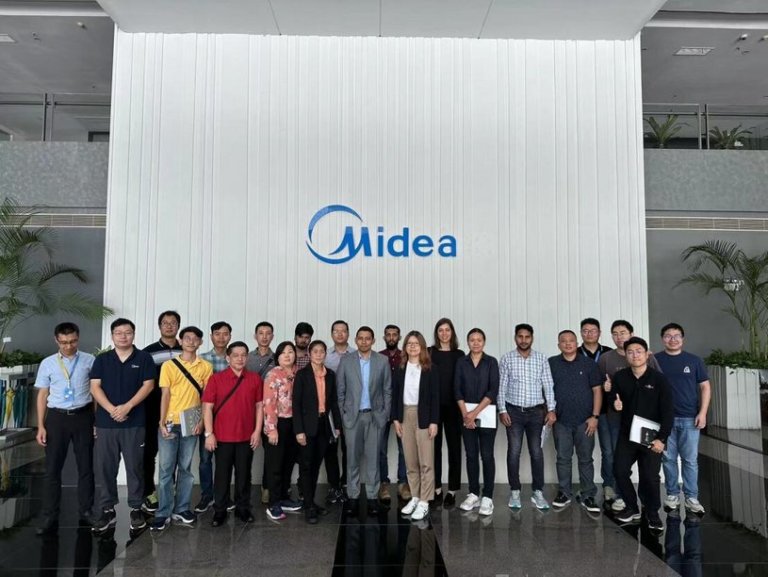
In this context and to further promote the digital transformation and green, low-carbon development of the retail sector, the Deutsche Gesellschaft für Internationale Zusammenarbeit (GIZ) and the China Chain Store & Franchise Association (CCFA) jointly held a field visit and workshop titled “Digitally Empowered for a Greener Future—Smart and Sustainable Retail Facilities” on 20 June in Shenzhen. The event brought together more than twenty representatives from 17 enterprises to visit Dingdong Maicai’s fruit and vegetable distribution center and the Sam’s Club Qianhai Store in Shenzhen, offering an on-site look at food safety and low-carbon technologies implemented by companies in the sector.
Quality control practices at fresh produce distribution center
In the morning, the delegation visited the Dingdong Maicai Dongguan fresh produce warehouse to gain insight into its quality control system. The representatives gave a presentation on the center’s measures for smart food safety digital management. A live demonstration was provided to showcase the operation logic of the digital supply chain and QMS (Quality Management System). The group then toured the quality control laboratory and warehouse operations to observe the standardised processes, from receiving goods and storing them, to processing and outbound sorting.

Both sides engaged in exchanges on quality control technologies and industry trends. The Dingdong team emphasised their ongoing commitment to strengthening food safety through management system improvement and technological innovation to elevate quality standards across the industry.

Green and low-carbon retail practices — visit to Sam’s Club Qianhai
In the afternoon, the delegation proceeded to the Sam’s Club Qianhai Store in Shenzhen. Its mother company, Walmart China, has been implementing energy-saving and emission-reduction measures across Walmart hypermarkets and Sam’s Clubs nationwide. The Qianhai store, the largest Sam’s Club in Shenzhen, was included in the Best Practice Collection of Green and Low-Carbon Demonstration Stores for Chain Enterprises (2023–2024), a compilation curated by CCFA. It serves as an industry reference in areas such as digital intelligent management, energy-saving renovations, clean energy use, and staff training on energy conservation.
Mr. Lin Xiaoyan, Director of Facility Management at Walmart China, introduced Walmart’s company-wide energy efficiency and emission reduction strategies, particularly highlighting the application of CO₂ trans critical refrigeration systems across multiple stores and efforts in thermal energy recovery and reuse.
In the retail sector, refrigerants are a major source of carbon emissions throughout the equipment lifecycle, closely tied to global environmental and climate issues. Mr. Wang Yin, Project Manager at GIZ, delivered a thematic training session titled “Advancing Green Transformation in Supermarkets: Current Status and Trends of Natural Refrigerants in the Retail Sector,” sharing global trends in the adoption of natural refrigerants and how technological innovations are helping the retail sector transition towards sustainability.

Notably, this training session also served as part of the promotion series for the retail industry’s first group standard on eco-friendly refrigerants: “Specification for Refrigerant Management of Retail Enterprises for Cold Chain Refrigeration Equipment and Systems” (T/CCFAGS 056-2025), offering standardised guidance for the industry’s low-carbon transformation.
During the subsequent on-site tour, the store manager guided the group through various features, including the digital intelligent management system, energy-efficient design of walk-in and back-up cold storage rooms, rooftop solar PV installations in the parking lot, and the CO₂ refrigeration equipment room.
In the final exchange session, Mr. Lin highlighted that low-carbon transition is not only a corporate social responsibility, but also a key pathway to improve operational efficiency and optimise cost structures. Through refined management of refrigeration and energy consumption, Sam’s Club has adopted a high-efficiency, low-margin business model, contributing to price competitiveness.
*This field visit and workshop are part of the Proklima projects in China, implemented on behalf of the German Federal Ministry for Economic Cooperation and Development (BMZ)