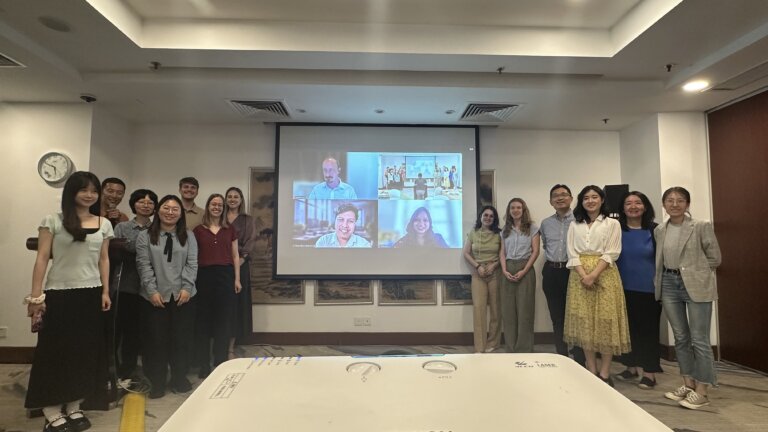
Building on exchanges between stakeholders from Thailand and China in 2024, the Urban-Act project organised a follow-up on Ecological Spatial Planning (ESP) in China.
The Thai delegation—comprising representatives from the Office of Natural Resources and Environmental Policy and Planning (ONEP), Chulalongkorn University (CU), and the Urban-Act Thailand team—visited Shanghai from 4–8 August 2025. They were accompanied by Tongji University, the Shanghai Tongji Urban Planning and Design Institute (TJUPDI), and the Urban-Act China office, with the aim of deepening dialogue on the development and implementation of ESP.
During the workshops held on 5 and 6 August, participants shared and discussed experiences, lessons learned, gaps, and challenges in ESP development in both countries. A key highlight was the comparative exchange between China and Thailand, which led to constructive discussions and consensus on recommended methodologies and datasets for developing and implementing the ESP process.
Following the two-day workshop, the delegation conducted on-site visits on 7–8 August to Zhuxiaohui, Xitang Town in Jiashan County, and the Water Town Living Room in the Yangtze River Delta Eco-Green Integrated Development Demonstration Zone, providing them with first-hand exposure to ecological spatial planning practices in China.
Participants from both countries expressed their interest in continuing the dialogue and exchanges in Thailand, with a view to fostering more concrete cooperations in ESP and related fields in the future.